How I Figured Out What Was Actually Happening
I stood in Nancy's basement and looked at the crack. It was a diagonal crack, roughly a quarter inch wide at the top, running from the corner where the uphill wall met the ceiling down toward the middle of the wall. That geometry told me something. Diagonal cracks like that usually come from one of two things. Either differential settlement, which would mean the foundation was sinking on one side. Or lateral pressure, which would mean something was pushing horizontally on the wall from outside. Settlement cracks tend to be wider at the top when the corner is dropping. Pressure cracks also widen at the top when soil is pushing against the upper portion of the wall.
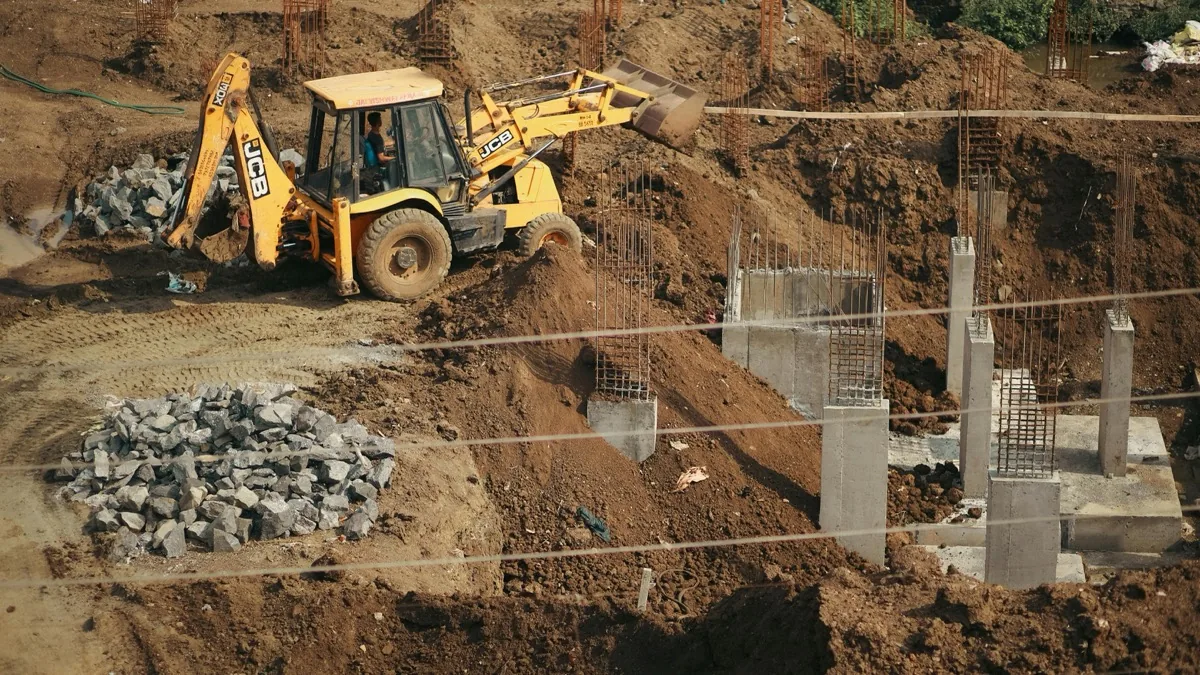
I went outside and looked at Nancy's uphill wall from the exterior. The soil grade against her foundation had risen. There was a distinct high point maybe four feet from the corner where the earth was piled up several inches higher than it should have been. That soil had come from behind the failing retaining wall next door. It had been slowly slumping downhill under gravity for years, and Nancy's foundation was catching it.
Confirming the Story With the Retaining Wall
I asked Nancy if I could take a closer look at the property line. She walked me over. The retaining wall was clearly failing. Two courses had rotated outward at the top. Water was seeping through the joints, meaning the drainage behind it had also failed. Old landscape timbers do not last forever. This one was probably at end of life when Nancy moved in and had gotten worse since.
Behind the wall there was a mound of dirt sloping down toward Nancy's foundation. That soil had nowhere to go except sideways and down. And every time it rained heavily, the mass of that soil got heavier and the pressure on Nancy's basement wall got worse.
Why the Contractors Missed This
The two foundation contractors who gave Nancy quotes had both diagnosed her cracks as settlement. Their proposed fixes were helical piers on the uphill side of her house, which is a settlement repair. If you install piers to fix a settlement problem that is actually a lateral pressure problem, you have not solved anything. The wall is still being pushed. The piers will hold the foundation from sinking, sure. But the cracks will keep opening because the sideways force is still there.
Neither contractor had walked the property. Neither had looked at the retaining wall next door. Neither had asked about drainage patterns or grade changes. They looked at the crack, saw a pattern that vaguely fit settlement, and priced out their standard settlement repair. This is one of those cases where the sales process shortchanged the diagnosis.
I told Nancy she needed a structural engineer to write an actual report. I gave her the name of a guy I have worked with before. Nancy paid him $650, which felt like a lot until she had the report in hand. He confirmed everything I had suspected. Lateral pressure from soil movement, driven by the failing retaining wall on the neighbor's property, with drainage problems compounding the situation.
The Legal Question That Came Next
Nancy's next question, which I had zero expertise to answer, was whether the neighbor was legally responsible for her foundation cracks. She ended up talking to a real estate attorney. What I learned from her situation, secondhand, is that lateral support law varies significantly by state. Some states hold uphill property owners responsible for lateral support of adjoining land. Others do not. The American Bar Association has resources on lateral support doctrine that were helpful for orienting her on what questions to ask her attorney.
In Ohio, where Nancy lived, the outcome hinged on whether the retaining wall had been installed for the benefit of the uphill property or the downhill property. That was a fact question and Nancy did not have great documentation. The situation eventually resolved through the neighbor's homeowner's insurance, but it took over a year.
What the Repair Actually Involved
Fixing Nancy's foundation was a two part job. Part one was addressing the lateral pressure. That meant getting the retaining wall on the neighbor's property rebuilt, which is what the insurance resolution paid for. The new wall used engineered segmental blocks with proper drainage behind it, replacing the failed timber wall. That stopped the ongoing soil movement.
Part two was stabilizing Nancy's basement wall. The engineer specified carbon fiber straps at four foot spacing across the affected wall, plus crack injection for the existing diagonal crack. The total for that work came in at $8,400 with a local contractor who had come highly recommended by the engineer. Compare that to the $27,000 the first two contractors wanted for helical piers, which would not have addressed the actual problem.
Nancy also had to regrade the soil against her foundation on the uphill side after the new retaining wall went in. That was another $2,200 for a landscaper to pull the mounded dirt back from her foundation and slope the grade properly away from the house.
Why Regrading Mattered
Even with the new retaining wall in place, the soil that had already accumulated against Nancy's foundation was going to keep exerting pressure until it was removed. And the improper grade meant that water from any future rain event was flowing toward her house instead of away from it. Regrading solved both problems in one step. Building code guidance in most jurisdictions calls for at least six inches of fall over the first ten feet away from a foundation wall, which is what Nancy's landscaper achieved.
What Nancy's Story Taught Me
I had never really thought about property-line drainage as a foundation risk before Nancy called me. My own house sits on a flat lot with no significant grade differences from my neighbors. But after seeing what happened at her place, I started paying attention to grade differences everywhere I went. And there are a lot of them. Anywhere one property sits meaningfully above another, some kind of retaining structure is doing work to keep soil from migrating downhill. When those structures fail, the downhill property is the one that pays.
The other lesson I took from Nancy's situation is how important the outdoor walk-around is for any foundation diagnosis. Two contractors stayed inside her house and quoted based on interior evidence alone. The actual cause was thirty feet away on someone else's property. If either of them had walked the lot line, they would have seen it. But they did not, because their business model is closing sales, not diagnosing problems. This is why I keep telling people that an independent structural engineer is worth the money before you sign a foundation repair contract.
What to Watch For on Your Own Property
Check the grade on all sides of your foundation once a year. Look for soil that has crept up against the wall higher than it used to be, mulch or landscape debris that has piled up over time, and any signs of drainage issues like water stains on the foundation or puddling within a few feet of the wall. If you have neighbors uphill from you, glance at any retaining walls or slope treatments between the properties. Bulging, leaning, and gap opening are all early warning signs of a wall about to fail.
If you see something concerning, do not wait for cracks to appear inside your basement. Deal with the outside problem first. Every dollar you spend on drainage and grade correction is worth about ten dollars of interior repair you will not have to pay for later.