What Vibration Actually Does to Concrete
Ground vibration from traffic propagates as a wave through soil. The energy dissipates with distance — by the time it reaches a foundation 100 feet away, it's much weaker than at the road surface. But it doesn't go to zero. And repeated low-level vibration over years does have cumulative effects on soil and concrete.
The mechanism isn't that vibration cracks concrete directly (unless you're talking about serious industrial equipment or blasting). It's more subtle. Repeated vibration can gradually compact loose or fill soil beneath a foundation, which leads to uneven settlement. It can also accelerate the widening of existing micro-cracks by causing repeated small stress cycles. Think of bending a paperclip back and forth — each individual movement does almost nothing, but eventually the metal fatigues.
Research from the Federal Highway Administration on traffic-induced ground vibrations generally notes that residential structures experience vibrations well below threshold levels for structural damage from normal road traffic. But threshold levels for structural damage and threshold levels for accelerating existing settlement are different things.
Tom's Actual Situation
When I looked at Tom's cracks, a few things stood out. The diagonal cracks at the corners were classic 45-degree step cracks — the kind you see from differential settlement, where one part of the foundation drops more than another. The horizontal crack along the wall was about 3/16 of an inch wide at its widest point, running roughly in line with the midpoint of the wall.
The horizontal crack worried me more than the diagonal ones. Horizontal cracks on basement walls usually mean lateral soil pressure is pushing the wall inward, and that can be a structural issue depending on how much movement has occurred. I ran a string line along the wall. There was about a quarter inch of bow over an eight-foot span. Not emergency territory, but not nothing.
The Soil Was the Bigger Factor
Tom's house sits on what the county GIS maps classify as fill material along a former drainage corridor. Fill soil is notorious for ongoing settlement because it compacts unevenly over decades. The diagonal corner cracks were consistent with differential settlement in fill — they'd likely have appeared even without the highway.
I also noticed his two downspouts terminated right at the foundation wall with no extensions. After every rain, water was pooling against the house and saturating that fill soil. Saturated fill settles faster and shifts more under load. That drainage situation was contributing more to his cracks than any truck going 65 miles an hour a hundred yards away.
What the Vibration Probably Did
That said, I don't think the highway was irrelevant. The repeated vibration probably accelerated the settlement process in that fill soil, and it may have contributed to the lateral pressure crack by cyclically stressing already-saturated soil against the wall. My read was that the highway was a secondary contributing factor, not the primary cause — but it wasn't zero.
When Traffic Vibration Is a More Serious Factor
Normal passenger vehicle traffic at reasonable distances is almost never the primary cause of foundation cracks. But there are situations where it becomes more significant.
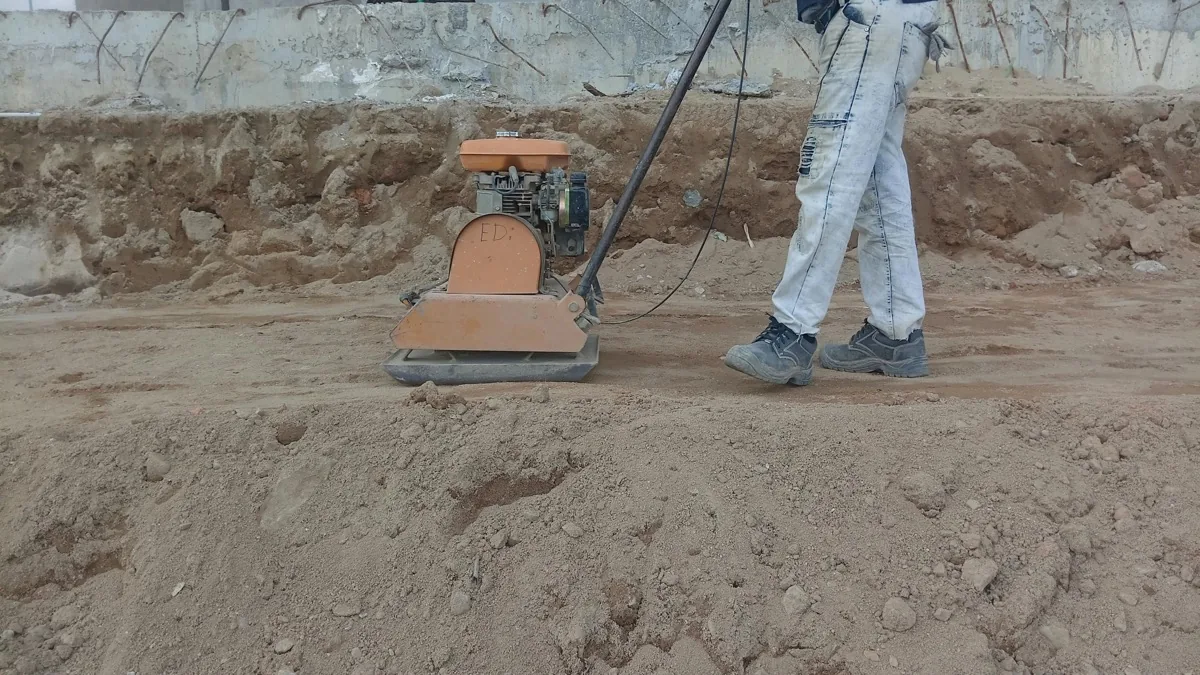
Heavy truck traffic is different from car traffic — a loaded semi exerts dramatically more ground pressure than a passenger car. If you live near a truck route, delivery hub, or industrial road with frequent heavy loads, the vibration profile is meaningfully different from a suburban street. Construction vehicles — dump trucks, concrete mixers, compactors — operating close to a structure can cause real problems, which is different from steady-state highway traffic.
The other factor is soil type. Dense, undisturbed clay or bedrock transmits vibration differently than loose fill, sandy soil, or soil with high water content. A house on fill near a truck route has more exposure than a house on undisturbed glacial till near the same road.
If you're specifically concerned about construction vibration from an active project nearby, that's covered separately in the article on construction vibration and foundation cracks, which gets into the specifics of PPV thresholds and what to document.
What We Did and What It Cost
I told Tom to get a second opinion before spending $6,800. He called a structural engineer for $425. The engineer agreed with my read — differential settlement in fill, probably accelerated by the drainage situation, with the highway as a minor secondary factor. He did not recommend wall anchors. He recommended fixing the downspouts, extending them six feet from the foundation, and monitoring the horizontal crack for six months with a crack gauge before deciding on any repair.
Tom did both for about $180 in materials. He installed crack gauges from a home improvement store and photographed them monthly. The crack has not grown in 14 months. The engineer said at that point, polyurethane foam injection for about $400 to $600 would be appropriate to seal the crack and prevent water entry, but it wasn't urgent from a structural standpoint.
He went from facing a $6,800 repair to a $605 total situation — and the most important step was just getting an independent opinion before assuming the worst.
The Bottom Line on Traffic Vibration
If your house is near a busy road and you have foundation cracks, the traffic isn't automatically the cause. Most of the time there are other factors — soil type, drainage, age of the structure, construction quality — that explain the cracks better than road vibration does.
That doesn't mean vibration is irrelevant. It means it's usually a contributing factor rather than the primary cause. The right approach is the same as with any foundation crack: understand what type of crack it is, assess whether it's active or stable, address any obvious drainage or moisture contributors, and get an independent structural opinion before agreeing to major repairs.
Tom's situation turned out fine. He still lives near that freeway on-ramp. He still feels the windows rattle a little when a loaded semi goes by. But his foundation is stable, his crack isn't growing, and he kept $6,000 in his pocket because he took the time to understand what he was actually looking at.