What Efflorescence Actually Is
Concrete, mortar, and concrete block all contain calcium hydroxide and other soluble compounds. When water infiltrates the material, it dissolves these compounds and carries them toward the surface. As the water evaporates at the exposed face of the wall, the dissolved minerals are deposited and form the white crystalline residue you're seeing.
Three conditions are required for efflorescence to form: soluble salts in the material, water to dissolve and transport them, and a pathway for the water to migrate to the surface. Remove any one of these and efflorescence stops. That's why treating the moisture source is the only lasting fix — cleaning the deposits without addressing the water pathway just means they'll reappear.
You'll find it most often on poured concrete basement walls, concrete block foundations, and brick or mortar joints in older construction. It tends to concentrate around cracks, at the base of walls where hydrostatic pressure is highest, and near tie rod holes or construction joints from the original forming process.
Active vs. Old Efflorescence
Not all efflorescence signals the same thing. There's a meaningful difference between deposits that are still forming and deposits that dried up years ago.
Active Efflorescence
Active efflorescence is damp, soft, or visibly growing over time. You might notice wet staining around it, or find that a patch you cleaned returns within a few weeks. This means water is currently moving through the wall. The source could be high groundwater after heavy rain, poor surface drainage, a downspout discharging too close to the house, or a plumbing leak. Active efflorescence warrants investigation into where the water is coming from.
Old, Dormant Deposits
Old efflorescence is dry, hard, and not expanding. It means water was moving through the wall at some point in the past — but may no longer be doing so. It could mean drainage was improved at some point, the seasons changed, or the crack essentially sealed itself with mineral buildup over time. Dormant deposits are worth noting and monitoring, but they don't necessarily mean there's an active moisture problem right now.
What Efflorescence Near a Crack Tells You
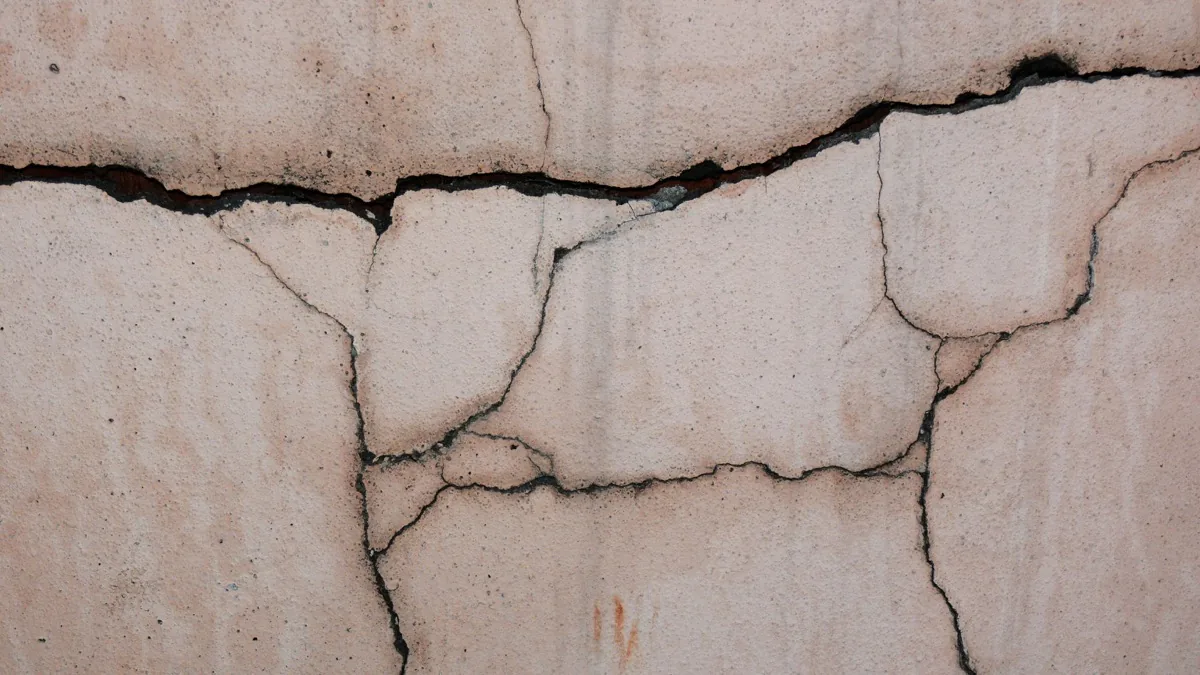
When you find efflorescence concentrated along a crack, that's useful information: water is using that crack as a pathway through the wall. The deposits are basically a mineral map of where moisture has been traveling.
This doesn't change the crack's structural classification. A hairline shrinkage crack with efflorescence deposits is still a hairline shrinkage crack. It's not suddenly structural because of the white powder. But it does confirm that the crack is permeable to moisture, which matters for basement humidity levels, mold risk, and the long-term durability of any repair you apply to it.
If you're planning to inject a crack with epoxy or polyurethane foam, active moisture in the crack will compromise the repair. The American Concrete Institute recommends addressing the water source before applying crack sealants, because injecting into a wet crack reduces bond strength and increases the chance of repair failure.
Distinguishing Efflorescence from Other Wall Problems
Efflorescence gets confused with a couple of other basement wall issues. Here's how to tell them apart.
Efflorescence vs. Mold
Mold is usually gray, green, or black. It has a fuzzy or irregular texture and a musty smell. Efflorescence is white or sometimes yellowish, has a crystalline or powdery texture, and has no smell. If you're not sure which you're looking at, apply a drop of bleach: mold will lighten or disappear; efflorescence won't change because it's mineral, not organic. Rubbing it also helps — efflorescence crumbles away; mold tends to smear.
Efflorescence vs. Spalling Block
On older block foundation walls, the surface of the block sometimes flakes or spalls — that's different from efflorescence. Spalling is usually caused by freeze-thaw cycles forcing water to expand inside the block material itself, causing the face to break away. Spalling looks like the block surface is peeling or fragmenting rather than a white deposit forming on top of it. Both indicate moisture problems, but they have different causes and different repair paths.
Cleaning and Addressing the Problem
Efflorescence scrubs off with a stiff brush and water for light deposits. Heavier buildup responds to diluted muriatic acid (follow product directions carefully — acid requires protective gear and neutralization rinse). But cleaning the deposits without fixing the moisture source means they'll return. The white crust is a symptom. The water pathway is the problem.
Permanent resolution usually involves one or more of these: improving exterior grading so water drains away from the foundation, extending or redirecting downspouts, applying exterior waterproofing membrane, sealing the specific crack or joint allowing water entry, or installing an interior drainage system for chronic moisture issues.
The EPA's guidance on building moisture consistently emphasizes controlling water at the source rather than managing it after it's inside. That principle applies directly here.
If efflorescence is widespread and actively forming on multiple walls, it's worth having a waterproofing contractor look at it — not because the structure is failing, but because persistent moisture infiltration degrades concrete and block over time, and the earlier you address a drainage or waterproofing problem, the cheaper the fix.