Settlement and Movement Terms
These terms describe how and why foundations move. Getting them straight helps you follow the conversation when a professional is explaining what's happening under your house.
Settlement
The gradual downward movement of a structure as the soil beneath it compresses under load. Nearly every building settles some amount in the years after construction. Settlement by itself isn't necessarily a problem. The problem is when it's uneven.
Differential Settlement
Settlement that doesn't happen uniformly across the foundation. One corner drops while another stays put, or one wall sinks faster than the others. This is the root cause of most serious foundation cracking. Uniform settlement compresses a structure evenly; differential settlement tears it apart at weak points.
The American Concrete Institute publishes guidance on tolerable differential settlement limits for different construction types. Wood-framed residential structures handle more differential movement than concrete or masonry buildings because wood has some flexibility.
Active vs. Dormant
An active crack is still moving or growing. A dormant crack formed at some point in the past and has stabilized. A contractor who calls a crack "active" is telling you the movement hasn't stopped yet. Dormant cracks still need monitoring to confirm they've stabilized, since something triggering new soil movement could reactivate them.
Heaving
Upward movement, the opposite of settlement. Heaving is typically caused by expansive soil absorbing water and swelling, or by frost pushing frozen ground upward. You'll see heaving most often in slab foundations and basement floors, though it can occur in walls too when wet soil presses from below.
Creep
Slow, continuous movement over time without a specific triggering event. Soil creep happens on slopes when soil slowly migrates downhill. Foundation creep refers to ongoing slow movement that may not be tied to seasonal cycles but just continues steadily. Harder to detect than sudden settlement, which is why long-term photo documentation matters.
Crack Description Terms
Contractors and engineers describe cracks using specific vocabulary that carries information about likely cause and structural significance. Here's what each term typically means in practice.
Hairline Crack
A crack less than about 1/16 inch wide. Hairline cracks are extremely common in concrete, often forming as concrete cures and dries in the months after pouring. Most are not structural concerns. The worry comes when hairline cracks multiply rapidly, appear in unusual locations, or begin to widen over time.
Step Cracking
Cracks that follow mortar joints in a block or brick foundation in a stair-step pattern. The crack takes the path of least resistance, which in block construction is through the mortar rather than through the block itself. Step cracking is a classic sign of differential settlement because the foundation is racking (twisting unevenly).
Horizontal Cracking
Cracks running parallel to the ground in a basement wall. This is the crack type professionals take most seriously. Horizontal cracks in basement walls usually mean the wall is bowing inward under lateral soil pressure. The International Code Council building code flags any inward bowing or horizontal cracking in basement walls as requiring engineering evaluation. If you have horizontal cracks and the wall also shows a visible curve inward, get a professional assessment promptly.
Diagonal Cracking
Cracks running at an angle, typically between 30 and 60 degrees from horizontal. Diagonal cracks usually indicate differential settlement, where part of the foundation has moved relative to an adjacent section. Windows and door openings are common starting points for diagonal cracks because they're stress concentration points in an otherwise solid wall.
Shrinkage Crack
A crack formed as concrete dries and contracts after the initial pour. Concrete shrinks about 0.05% linearly as it cures, and restraints in the form prevent uniform contraction, so cracks form to relieve the stress. Shrinkage cracks are vertical or random in pattern, typically thin, and usually stable once the curing process is complete. They're often the first thing a contractor should rule out before diagnosing something more serious.
Cold Joint
A visible line where two separate concrete pours met. In older foundations, concrete was often poured in stages, and if the first pour had hardened before the second was added, the bond between them was incomplete. Cold joints look like cracks and can leak water, but they're construction interfaces, not damage. They're typically horizontal and run the full length of a wall.
Spalling
Flaking or chunking of concrete from the surface, usually from freeze-thaw cycles forcing moisture through pores, or from embedded rebar corroding and expanding. Spalling is surface deterioration rather than structural cracking, but it can expose reinforcing steel to moisture and accelerate long-term damage if ignored.
Map Cracking
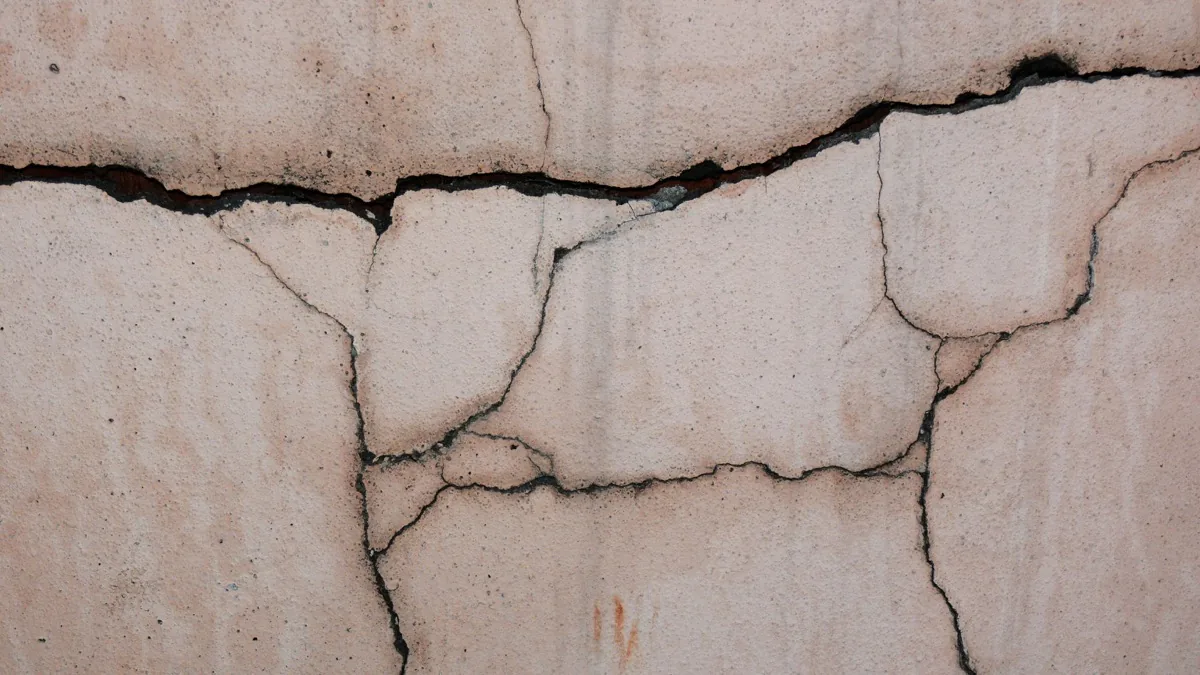
Also called crazing. A network of shallow interconnected cracks covering a surface area like a road map. Usually caused by surface concrete drying faster than the interior, or by alkali-silica reaction in the concrete mix. Rarely a structural concern but worth mentioning to an engineer if it covers a large area.
Load and Force Terms
These describe what's pushing, pulling, or pressing on your foundation. Understanding the forces helps explain why certain crack types occur in certain locations.
Hydrostatic Pressure
The force water exerts against a below-grade surface. When soil around a basement saturates after heavy rain or snowmelt, water presses against the wall from every direction. Hydrostatic pressure is the primary driver of water intrusion in basements and can cause cracking when drainage systems are overwhelmed or absent.
Lateral Pressure
Horizontal force from soil pushing against a foundation wall. Soil always exerts some lateral pressure just from its weight. When soil is wet, frozen, or overloaded by something on the surface, that pressure increases. A basement wall that can't resist lateral pressure bows inward and eventually cracks horizontally.
Surcharge Load
Additional weight placed near the foundation that adds to the lateral pressure on the wall. Heavy equipment parked close to the house, a new concrete driveway on one side, or a large planting bed filled with heavy soil can all create surcharge that wasn't part of the original design. This shows up on foundation inspection reports when the engineer is explaining why a wall is stressed beyond what normal soil pressure would cause.
Bearing Capacity
How much load the underlying soil can support before it compresses or shifts. Undisturbed native soil generally has higher bearing capacity than fill dirt or disturbed soil. If a foundation was built on inadequately compacted fill, bearing capacity may be insufficient and settlement results over time.
Engineering Report Terms
If you've received a written engineering report, some of these terms may appear. They're precise descriptions of measurements and conditions.
- Plumb: Perfectly vertical. When an engineer checks if a wall is plumb, they're measuring whether it tilts inward or outward. An out-of-plumb basement wall is bowing.
- Deflection: The degree to which a structural member bends under load. Acceptable deflection limits for walls, beams, and floor joists are defined in building codes. Measured deflection beyond those limits requires remediation.
- Tension crack: A crack formed when tensile forces pull concrete apart. Concrete is strong in compression but weak in tension, so differential settlement creates tensile failure in predictable locations.
- Void: An empty space beneath a slab or footing where soil has eroded or compacted away. Voids leave concrete unsupported and can cause sudden cracking or collapse. Common under concrete driveways and patio slabs near older drainage.
- Drain tile: Perforated pipe installed at the base of the foundation to collect and redirect groundwater. Interior and exterior drain tile systems address water intrusion differently, and engineers often specify which is appropriate for a given situation.
- Piping: The migration of soil particles through cracks under water pressure, which creates voids over time. Piping is a process, not a pipe. It means your foundation has a crack serious enough that water flowing through it is carrying soil with it.
The American Society of Civil Engineers publishes guidelines for structural assessment that engineers use when evaluating residential foundation conditions and writing these reports.
Terms That Should Make You Pay Closer Attention
A few words in contractor quotes and engineering reports warrant extra scrutiny when you see them.
Imminent failure is a serious engineering term that should not be used loosely. Legitimate engineers use it sparingly, only when structural collapse is a real near-term risk. If a contractor uses it but hasn't provided a written engineering report, treat it with skepticism and get an independent opinion.
Active movement in a report means the problem hasn't stopped. Whatever is causing the cracking is still in progress. This matters because some repairs are ineffective on foundations still moving.
Undermining refers to erosion or removal of soil beneath the footing, reducing its support. When engineers mention undermining, they're describing a loss of the soil the foundation was built to rest on.
For any of these terms, getting a second opinion from an independent structural engineer before signing a repair contract is money well spent.