What Pop-Outs Look Like
A pop-out is a roughly conical fragment of concrete that has broken away from the surface. The visible result is a shallow depression, usually circular or oval, with a small piece of aggregate visible at the bottom or a void where the aggregate used to sit. The typical size range runs from 1/4 inch to about 4 inches across, though larger ones occur occasionally.
Pop-outs are most commonly seen on horizontal surfaces like garage slabs, basement floors, and exposed footings, but they appear on vertical foundation walls too. On a vertical wall, you might see a few scattered across the surface, sometimes clustered in a particular area where the aggregate quality was inconsistent during pouring.
The defining feature is that pop-out damage stops at the surface layer. The concrete underneath the pop-out is sound. Probing with a screwdriver into a pop-out depression will hit solid concrete almost immediately. This is different from spalling, where the damage often goes deeper.
What Causes Pop-Outs
Pop-outs are caused by a specific aggregate particle inside the concrete expanding more than the surrounding cement paste can accommodate. The expansion fractures the concrete cover above the particle, creating the characteristic conical fragment.
The expansion has two common drivers. Freeze-thaw of moisture absorbed by a porous aggregate particle is the most frequent cause in cold climates. Some aggregates absorb water, freeze, and exert enough pressure during the freeze cycle to fracture the cover concrete above them. Alkali-aggregate reaction is the other major cause. Certain reactive aggregates expand chemically when exposed to the alkaline pore water in cement paste, producing the same outward pressure over a longer time scale.
The reason pop-outs are not generally a structural concern is that the expansion happens at a single aggregate particle, not throughout the concrete mass. The surrounding concrete remains intact. A foundation can have dozens of pop-outs and still be perfectly sound structurally. They look bad, and that is the main consequence.
What Spalling Looks Like
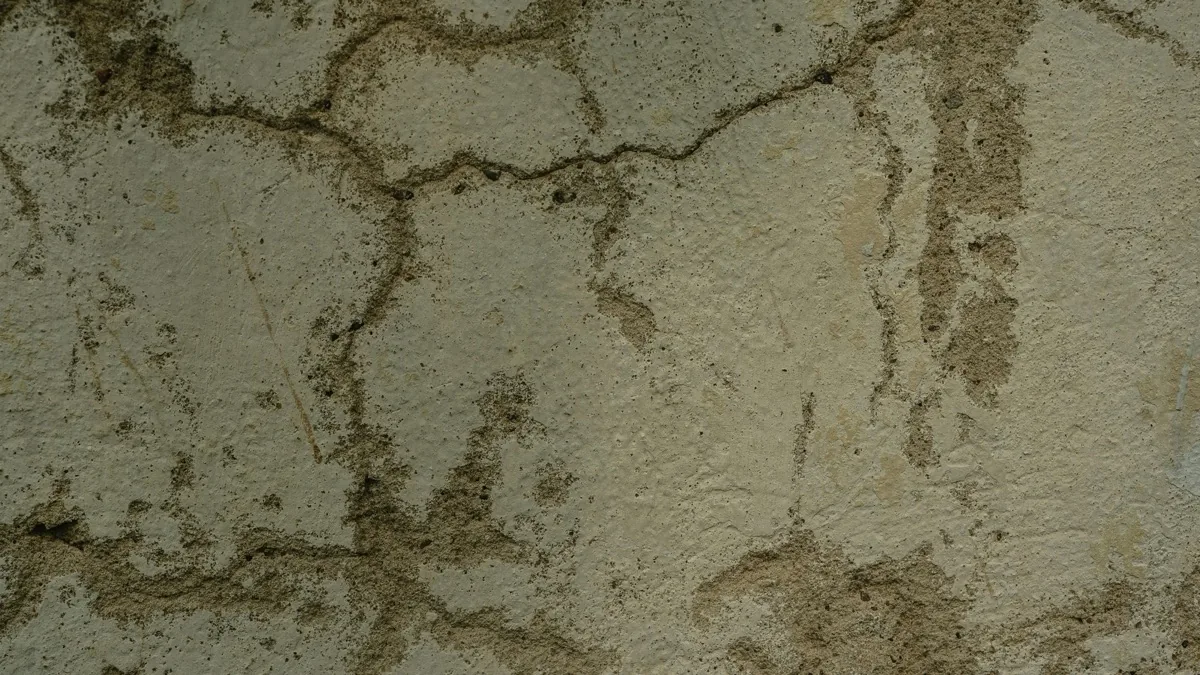
Spalling is broader surface damage. Instead of a discrete conical chip at a single point, spalling appears as flaking, scaling, or chipping across a larger area of concrete surface. The damaged zone might be a few inches across or might extend across several feet of foundation wall.
Surface spalling presents as a roughened, sometimes powdery appearance with thin layers of concrete coming away from the substrate. Deeper spalling exposes the coarse aggregate inside the concrete, leaving an irregular pitted surface. The most serious spalling exposes the steel reinforcement, which is a clear escalation from cosmetic to structural concern.
One useful diagnostic: spalling tends to follow patterns related to its cause. Freeze-thaw spalling concentrates near grade level where the foundation is exposed to repeated wetting and freezing. Rebar corrosion spalling follows the lines of the reinforcement, producing a linear damage pattern often with rust staining. Chemical spalling appears wherever the concrete contacts the chemical source, which might be road salt at the bottom of a foundation wall or fertilizer overspray on an exposed footing.
Distinguishing Spalling from Pop-Outs
The simplest test is pattern and area. Pop-outs are discrete points with clear edges. Spalling covers continuous areas with irregular boundaries. A wall with twenty pop-outs scattered across it is showing pop-out damage. A wall with one area that has lost surface material across a 2-foot section is showing spalling. They can coexist on the same foundation, but they are different phenomena with different implications.
Common Causes of Spalling
Freeze-thaw cycling is the leading cause of spalling on exposed foundation concrete in cold climates. Water that has penetrated the surface layer expands when it freezes, fracturing the surface in thin layers. Each cycle removes a small amount of material. Over many winters, the cumulative damage can become substantial. Foundations without air-entrained concrete are particularly vulnerable since air entrainment provides voids that accommodate the freeze expansion.
Rebar corrosion is the second major cause and the more structurally significant one. Steel reinforcement that has been exposed to water and oxygen for years will corrode. Corroding steel expands to several times its original volume, which exerts outward pressure on the concrete cover. The cover eventually fractures, then spalls off in chunks. This pattern is common in older foundations where the rebar was installed too close to the surface or where the concrete cover was inadequate from the start.
Chemical attack accounts for less spalling but is worth knowing about. Sulfate-bearing soils, acidic groundwater, road de-icing salts, and certain industrial chemicals can all degrade concrete over time. The damage typically appears at the location of the chemical contact rather than being distributed across the foundation.
When Surface Damage Becomes Structural
Pop-outs almost never reach the threshold of structural concern on their own. The damage stops at the surface, the concrete below remains intact, and the load-bearing capacity of the foundation is unaffected. Cosmetic repair is optional and depends on how much the appearance bothers the homeowner.
Spalling crosses into structural territory under specific conditions. The first is depth. Surface scaling of less than 1/4 inch is cosmetic. Spalling that has progressed to 1/2 inch or deeper has removed enough material that the protective cover over reinforcement is compromised. The second is exposure of rebar. Once steel is visible, the corrosion process accelerates dramatically since the exposed surface area is much larger. The third is location. Spalling on a non-load-bearing exposed pier face has less consequence than spalling on a wall that carries vertical loads from above.
The most reliable way to evaluate whether your spalling has reached structural significance is to have a structural engineer look at it. The cost is typically $300 to $700 for a residential evaluation and provides documentation that homeowners can use for insurance, real estate disclosure, or repair planning.
Repair Approaches
Cosmetic pop-out repair is straightforward. The pop-out depression can be cleaned out, primed with a bonding agent, and filled with a polymer-modified concrete patching compound. The repair is purely visual. Many homeowners choose not to bother since the patches rarely blend perfectly with surrounding concrete and the underlying foundation does not need the work.
Surface-level spalling repair uses similar materials applied across the affected area. The damaged surface is removed mechanically, exposed sound concrete is cleaned and primed, and a patching compound is applied. For larger areas, a parge coat or surface bonding mortar may be applied across the entire wall to produce a uniform appearance.
Spalling involving rebar exposure or significant depth requires a more involved repair. The process typically includes removing all unsound concrete back to clean material, treating the exposed steel to arrest corrosion, applying a corrosion inhibitor, and rebuilding the section with a structural repair mortar. The International Code Council provides general guidance through the International Existing Building Code, and most jurisdictions require permits for structural concrete repair on residential foundations. Confirming local permit requirements before starting the work is worth the phone call.