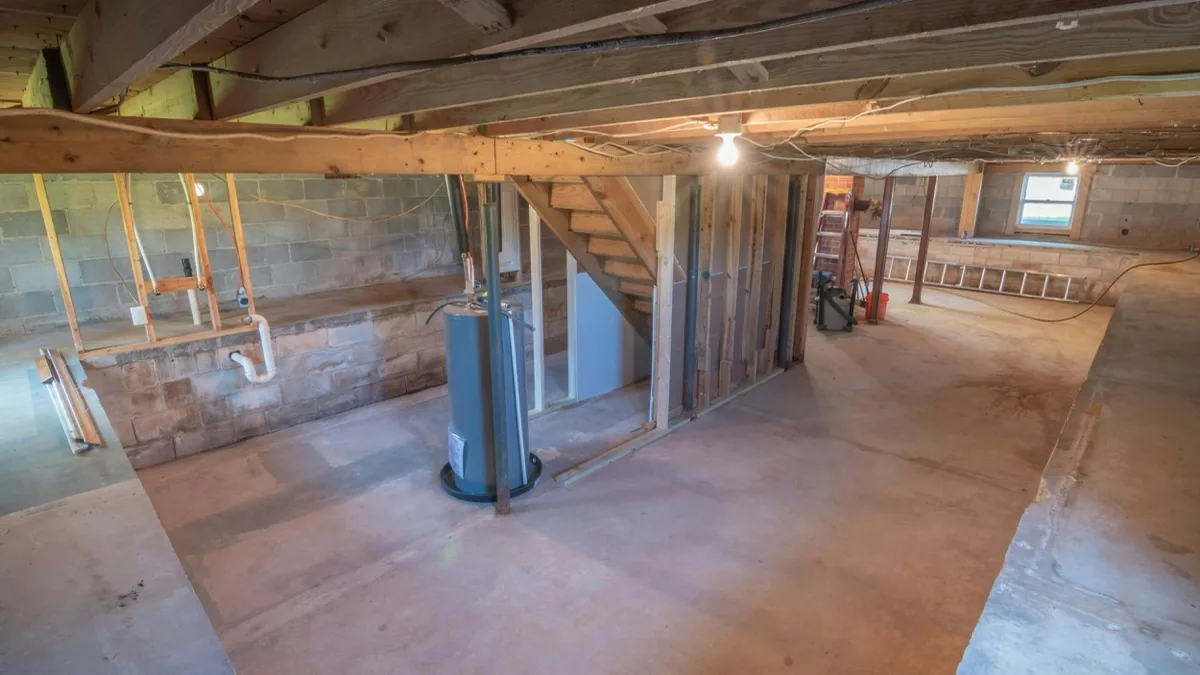
Quick Comparison
| Characteristic | Poured Concrete | Concrete Block |
|---|---|---|
| Common crack pattern | Vertical, diagonal | Stair-step, horizontal at mortar |
| Where cracks form | Through concrete itself | Along mortar joints |
| Typical shrinkage cracks | Vertical hairlines | Usually none visible |
| Structural failure mode | Horizontal crack + bowing | Stair-step or horizontal at mid-height |
| Repair complexity | Moderate | Often more complex |
How Poured Foundations Crack
Poured concrete is one continuous mass. When it cracks, it cracks through itself. According to the International Code Council, understanding the underlying cause is the first step toward a solution.
Shrinkage Cracks
Almost every poured foundation has vertical shrinkage cracks. They form as the concrete cures and loses moisture. Typically appear near windows, corners, or places where the wall changes thickness.
I have four vertical cracks in my basement. All of them have been exactly the same since 1978. They're part of the wall now, not problems.
Structural Cracks
When a poured wall fails structurally, you'll typically see a horizontal crack with the wall bowing inward below it. The crack forms where the wall is weakest under lateral soil pressure, usually about halfway up.
Sometimes you'll see diagonal cracks from corners, indicating uneven settlement. But the classic failure mode is horizontal crack plus bow.
Why Poured Is Often Better
Poured concrete is monolithic. No joints to fail. When engineers design repairs, they're working with a single mass of concrete. Carbon fiber straps bond well. Epoxy injection seals completely. The repairs are typically more straightforward.
How Block Foundations Crack
Block foundations are stacks of individual blocks held together by mortar. The mortar is the weak point.
Stair-Step Cracks
The classic block foundation crack follows the mortar joints in a stair-step pattern. It's not cracking through blocks; it's separating at the joints. This pattern indicates diagonal stress, often from settlement or soil pressure.
Jerry's first crack was a stair-step pattern starting near his basement window. The pattern itself told the contractor what kind of forces were at work.
Horizontal Cracking
Like poured walls, block walls fail horizontally under soil pressure. But the crack follows a mortar course instead of cutting through concrete. You'll see the wall bowing in the middle, with the horizontal mortar joint opening up.
Jerry's horizontal crack ran along one mortar course for almost the entire length of his back wall. Classic block wall failure pattern.
Why Block Is More Vulnerable
Mortar is weaker than concrete. The joints are natural failure points. Water can seep through mortar more easily than through solid concrete. And once a mortar joint starts to fail, it tends to progressively deteriorate.
Block walls also can't be repaired with epoxy injection the same way poured walls can. The blocks themselves might be fine while the mortar between them is failing.
Repair Differences
Same symptoms, different solutions.
Crack Sealing
Poured concrete cracks can be injected with epoxy or polyurethane. The crack is filled completely, and in the case of epoxy, structurally bonded.
Block walls require repointing, which means grinding out the failing mortar and replacing it. Or the whole wall section might need parging with a waterproof coating. Different skill set, different materials.
Structural Repair
Both wall types can be stabilized with carbon fiber straps or wall anchors. But block walls sometimes need additional work like filling hollow cores with concrete, or installing rebar through the blocks.
Jerry's contractor filled his blocks with concrete before installing anchors. That added cost and time that wouldn't apply to a poured wall.
Cost Implications
Block wall repairs often cost more. More labor, more materials, more complexity. Jerry's anchor installation was about 30% more expensive than a comparable poured wall job would have been, according to his contractor.
How to Tell What You Have
Not always obvious, especially if the walls are painted or finished.
Look for Joint Lines
Block walls have visible horizontal and vertical lines where the mortar is. Even under paint, you can usually see a slight pattern. Poured walls are smooth or textured but uniform.
Knock on the Wall
Block walls sound hollow. There's air inside those blocks. Poured concrete sounds solid. The difference is obvious once you know what you're listening for.
Check Corners
Block corners show the block pattern clearly. You can see the overlapping pattern where blocks from each wall interlock. Poured corners are continuous.
Which Is Better?
If I were building a house tomorrow, I'd want poured concrete. But that doesn't mean block is bad.
Poured Advantages
Stronger against lateral pressure. No joints to fail. Easier to waterproof. Easier to repair. Generally longer lifespan without issues.
Block Advantages
Cheaper to build, especially historically. Easier to construct without specialized equipment. The blocks themselves are strong; it's just the joints that are vulnerable.
Living With Either
Millions of homes have block foundations and do just fine. Jerry's parents have lived in their 1962 block-foundation house for 50 years with zero foundation issues. It's not inherently problematic; it just has different failure modes to watch for.