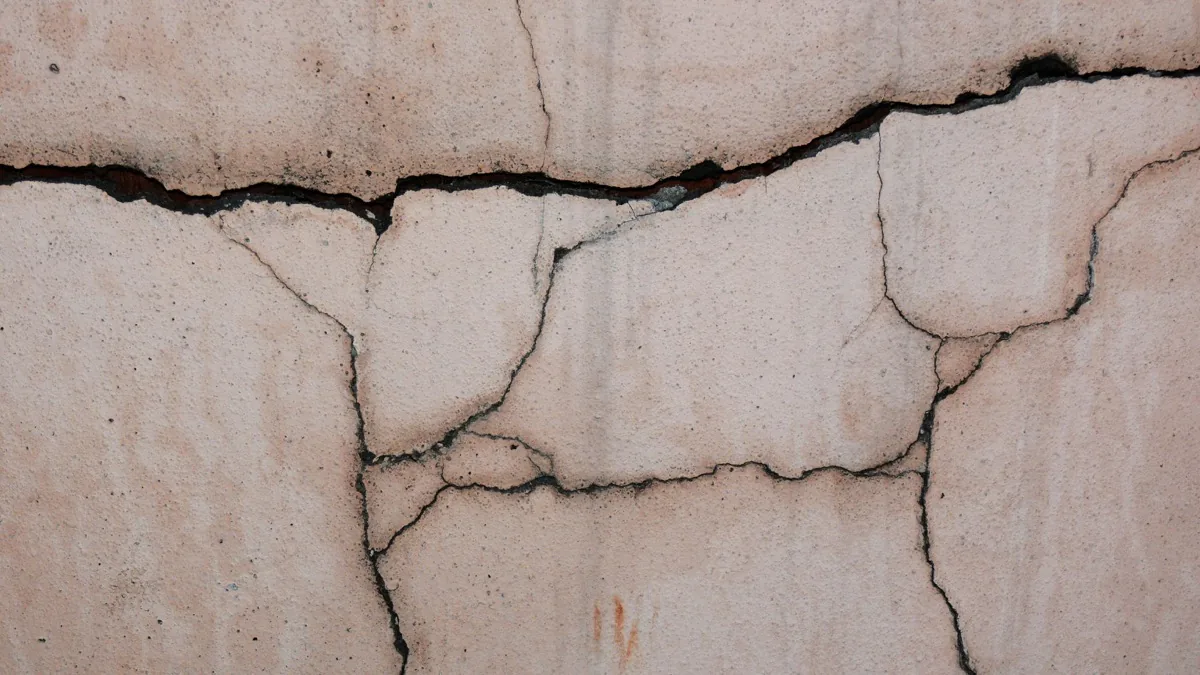
Types of Slab Foundation Cracks
Cracks in slab foundations fall into a few categories based on their appearance and cause. The American Concrete Institute classifies the recommended approach depends on several site-specific factors.
Shrinkage Cracks
These appear within the first few years after construction as concrete loses moisture and contracts. They're typically hairline width (less than 1/8 inch), straight or slightly wandering, and don't show vertical displacement where one side is higher than the other. Shrinkage cracks are cosmetic, not structural.
Settlement Cracks
When soil beneath the slab compresses unevenly, settlement cracks form. They're often wider than shrinkage cracks and may show one side sitting lower than the other. Minor settlement is normal for most homes. Significant settlement, where you can feel the floor slope or cracks exceed 1/4 inch, needs professional assessment.
Heaving Cracks
The opposite of settlement. When soil expands from moisture or frost, it pushes the slab upward. Heaving cracks often appear near plumbing penetrations where water may be adding moisture to the soil, or near exterior walls where drainage directs water toward the foundation.
Pattern Cracking (Map Cracking)
A network of interconnected cracks resembling a road map. This usually indicates problems with the concrete mix or curing process rather than structural movement. It's ugly but typically limited to the surface layer and doesn't affect structural integrity.
Crack Characteristics That Matter
When evaluating a slab crack, look at these features: According to the International Code Council, the recommended approach depends on several site-specific factors.
Width: Hairline to 1/8 inch is usually cosmetic. 1/8 to 1/4 inch warrants monitoring. Over 1/4 inch needs professional evaluation.
Vertical displacement: If one side of the crack sits higher than the other, the slab has moved. Run your finger across the crack. Even small differences you can feel indicate differential movement.
Pattern: Isolated cracks differ from multiple parallel cracks or cracks radiating from a point. Multiple cracks in a pattern suggest soil issues or structural stress.
Location: Cracks near load-bearing walls, around columns, or at the perimeter of the slab have more structural significance than cracks in the middle of a room.
Common Causes
Understanding why cracks form helps assess their significance:
- Concrete shrinkage: Normal, happens during curing, creates hairline cracks
- Soil consolidation: Soil compacting under weight, causes gradual settlement
- Expansive clay: Soil swelling when wet, shrinking when dry, causes seasonal movement
- Poor drainage: Water pooling near foundation, saturating soil
- Plumbing leaks: Underground leaks adding moisture to soil, common cause of localized problems
- Tree roots: Can both extract moisture (causing shrinkage) or physically displace soil
When to Call a Professional
Get a structural engineer's evaluation if you see:
- Cracks wider than 1/4 inch
- Any crack with noticeable vertical displacement
- Multiple cracks in a pattern suggesting systematic movement
- Cracks that have grown wider or longer over time
- Interior symptoms like sticking doors, cracked drywall, or sloping floors
- Cracks accompanied by water intrusion
A structural engineer (not a foundation repair contractor) gives you an unbiased assessment. Contractors have a financial incentive to recommend repairs.
Monitoring Slab Cracks
For cracks that don't meet the threshold for professional evaluation, monitoring tells you if they're stable or progressing.
Simple monitoring: Mark the ends of the crack with a pencil and date. Measure the width with a crack gauge or reference card. Check monthly for the first year, then quarterly.
If a crack hasn't changed in 12 months, it's likely stable. If it's growing, document the rate of change and consider professional evaluation.
Slab vs. Other Foundation Types
Slab foundations differ from basements and crawl spaces in a few important ways:
Access is limited. You can't see what's happening under the slab without expensive investigation. This makes hidden issues like plumbing leaks more problematic.
Repair options are different. You can't install traditional wall anchors or braces. Slab repairs typically involve underpinning (helical piers, push piers) or foam injection to stabilize or lift settled sections.
Costs vary. Minor crack repair is often cheaper than basement work. Major structural repairs requiring underpinning can be more expensive because of the access limitations.